


%20copy.jpg)

%402x.svg)
There is a particular quality to mornings in Lombok that is difficult to recreate elsewhere.
The day often begins without urgency. Light moves slowly across the hills. The sound of birds and distant activity replaces the noise of a busy city, while the landscape remains remarkably present: dry grasslands, coconut palms, cultivated fields, forested hills and, beyond them, the volcanic peaks that shape the island's horizon.
For travellers increasingly interested in wellness, this sense of space may be more valuable than any conventional spa treatment.
Lombok's appeal lies partly in what it has not yet become. While neighbouring Bali has developed into one of Southeast Asia's most established tourism destinations, parts of Lombok still offer a different relationship between people, landscape and development. The island is growing, particularly around the south, but there remains an opportunity to consider what tourism should look like before the landscape becomes secondary to it.
This is where wellness and eco-tourism begin to overlap.
Rather than treating wellness as something contained within a spa, hotel room or scheduled activity, Lombok suggests a broader interpretation: wellness as an experience of place. It can mean walking through a landscape, spending time outdoors, eating locally, sleeping with natural ventilation, or simply having enough quiet to notice the changing light during the day.
For architecture and hospitality, that idea has important consequences.
.jpg)
Read More: Hidden Gems and Local Experiences: Discovering a Slower Side of Lombok
Wellness Begins With Place
Modern wellness travel is often associated with treatments, fitness programmes, meditation rooms and carefully designed menus. These can all be valuable, but they are only part of the experience.
The physical environment itself can influence how people rest and recover.
In Lombok, nature is difficult to separate from daily life. The climate encourages outdoor living, while the landscape provides a natural rhythm to the day. Morning and evening temperatures create different ways of inhabiting a space. Wind moves through vegetation. Sunlight changes the character of a building over several hours.
Good architecture does not necessarily need to compete with these conditions. It can simply allow them to be felt.
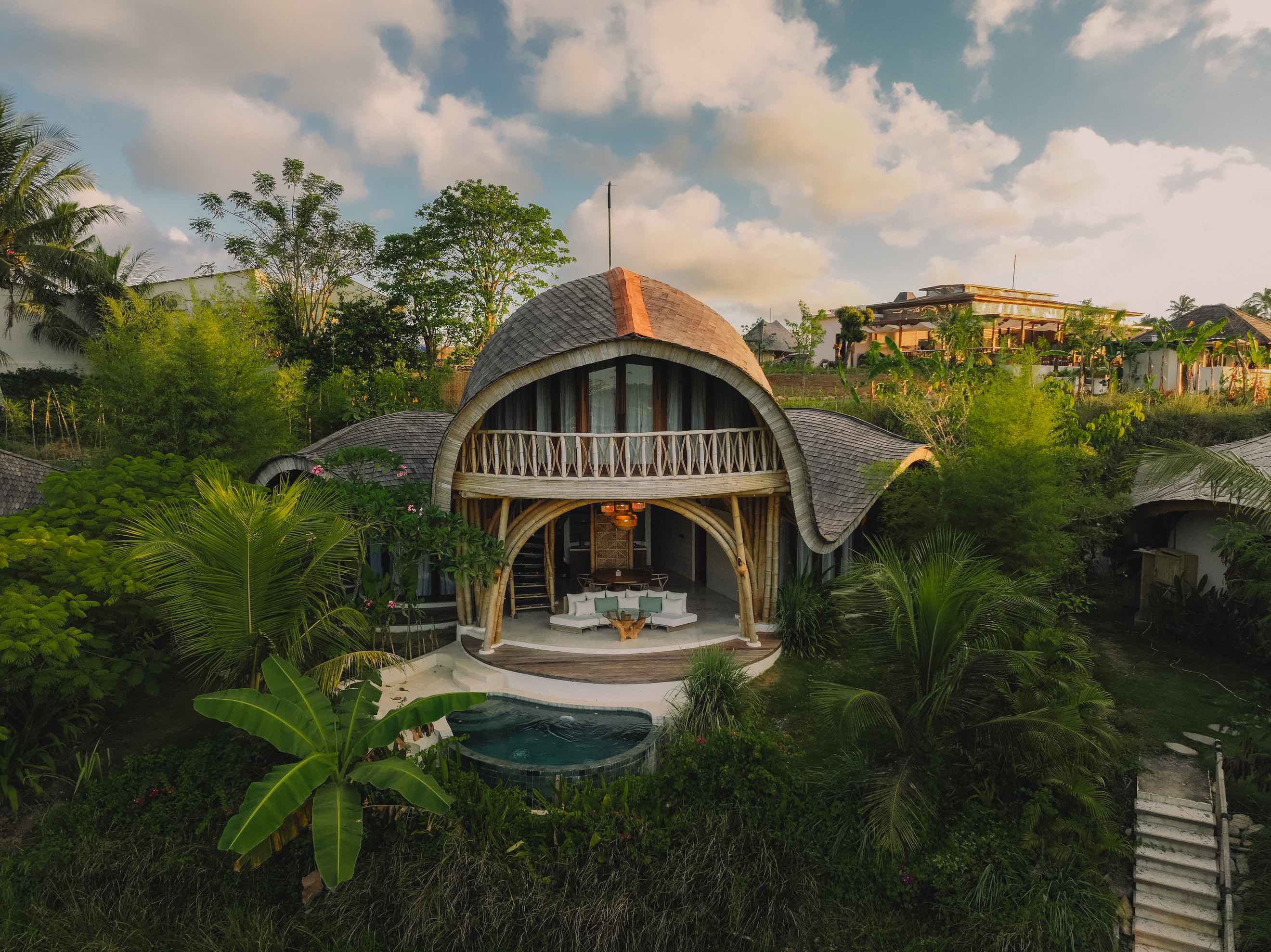
At Mandala, this thinking is reflected in the relationship between architecture and the surrounding landscape. Rather than treating the natural environment as a backdrop to the buildings, the design seeks to frame views, preserve a sense of openness and allow the landscape to remain part of the experience.
The use of bamboo is particularly relevant. Bamboo has a long history as a building material across tropical regions, including Indonesia, where it has traditionally been used for structures, furniture and everyday objects. In contemporary architecture, it offers another possibility: combining a material rooted in local building culture with modern structural and design approaches.
The result can feel less like an object placed on a site and more like an extension of its surroundings.
This distinction matters. A wellness retreat does not necessarily need to look like a retreat. Sometimes the most restorative spaces are those that feel naturally connected to where they are.
.jpg)
Nature as an Everyday Experience
Eco-tourism is sometimes reduced to a set of activities: hiking, snorkelling, wildlife watching or visiting conservation sites. These experiences are important, but responsible tourism can also be understood through something quieter—the way a development interacts with its immediate environment.
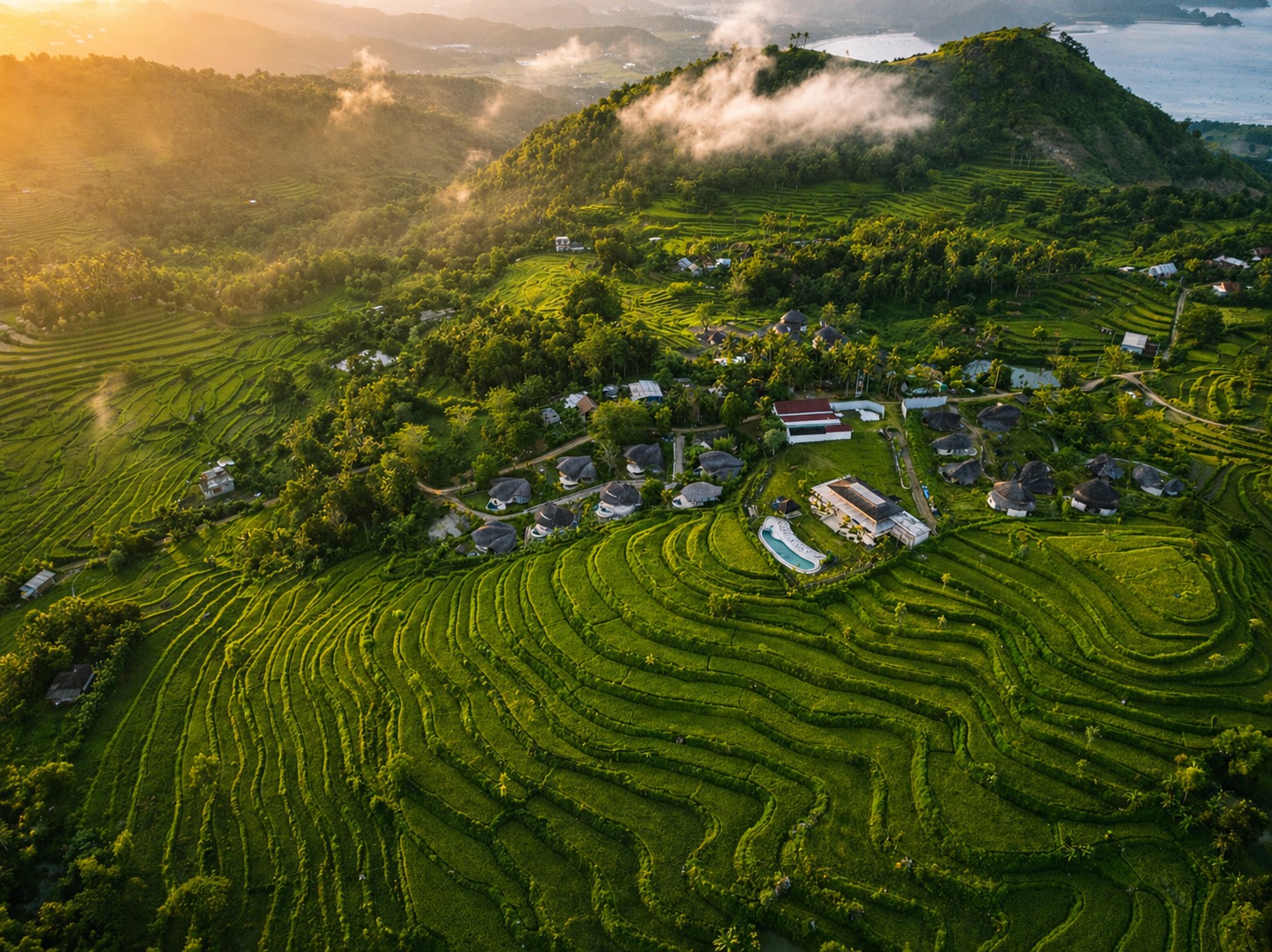
Lombok's landscapes are varied despite the island's relatively compact scale. The southern region is characterised by limestone hills, open grasslands, coastal areas and small agricultural communities. Further north, the landscape changes dramatically around Mount Rinjani, one of Indonesia's most prominent volcanic mountains.
This diversity creates opportunities for tourism that does not depend entirely on built attractions.
The landscape itself becomes the reason to travel.
For visitors, this can mean spending less time moving between destinations and more time understanding one place. A morning walk can become a way of observing local vegetation and farming patterns. A drive through the countryside can reveal how villages, fields and roads relate to the terrain. Even sitting quietly outdoors can become a form of engagement with the environment.
This slower approach is particularly relevant to wellness.
There is a difference between consuming nature and experiencing it.
When a landscape is simply treated as something to photograph, it remains external. When architecture, pathways, gardens and outdoor spaces allow people to inhabit it, the relationship becomes more intimate.
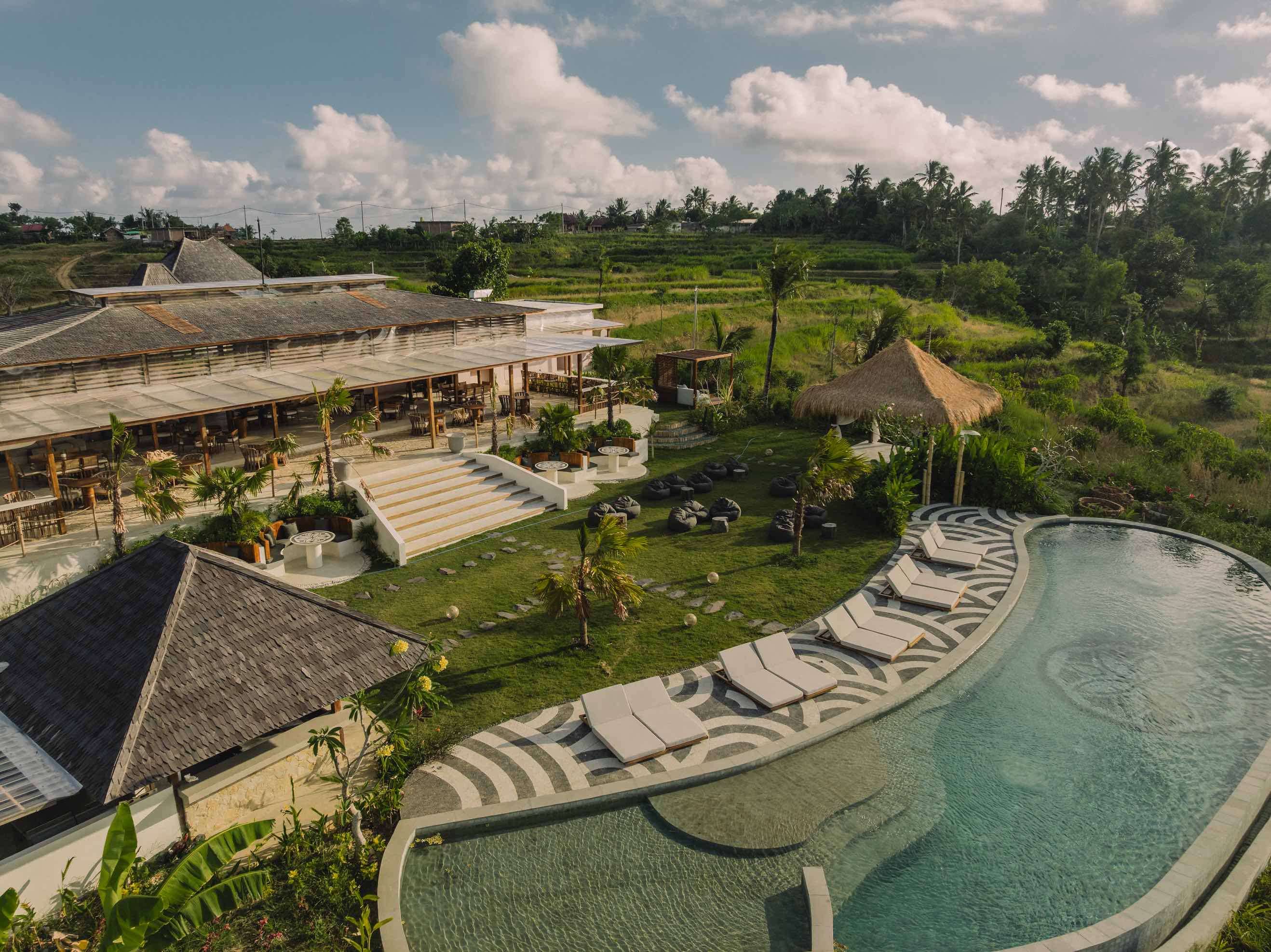
At Mandala, landscaping and architecture are therefore important parts of the experience rather than decoration added after construction. The intention is to allow vegetation, views and outdoor spaces to contribute to how guests move through the property.
.jpg)
The Value of Building With What Belongs Here
Sustainability in tropical architecture is not only about adding technology to a building. It can begin with a much simpler question:
What does the place already know?
Lombok has a long tradition of working with natural materials and responding to a tropical climate. Traditional buildings and settlements developed with an understanding of shade, airflow, rain and the relationship between indoor and outdoor spaces.
Contemporary hospitality architecture can learn from these principles without simply reproducing traditional forms.
At Mandala, bamboo becomes one expression of that approach. Its visual character is unmistakably connected to the tropical environment, while its structural possibilities allow architects to create large, open spaces that respond to the surrounding landscape.
Material choices also influence how a building feels over time. Bamboo has texture, variation and a visible relationship with craftsmanship. Unlike perfectly uniform industrial finishes, it can retain a sense of the material from which it came.
That human quality is important in hospitality.
A building can communicate sustainability through a technical specification, but it can also communicate it through what guests can actually see and touch.
The same principle applies to construction. Working with local craftspeople and materials can create a stronger connection between a project and its region, while preserving knowledge that might otherwise become less visible in increasingly standardised development.
Sustainability, in this sense, becomes cultural as well as environmental.
.jpg)
Eco-Tourism Without Losing the Local Rhythm
As Lombok becomes more visible internationally, tourism will inevitably bring change. New roads, hospitality projects, restaurants and residential developments can create employment and investment, but growth also creates pressure.
The question is not whether Lombok should develop.
It is how.
A sustainable tourism model needs to consider more than the experience of the visitor. It must also consider the communities who live in the destination, the resources required by new developments and the landscape that makes the destination attractive in the first place.
This is particularly important in areas such as South Lombok, where tourism development is accelerating.
The best eco-tourism does not attempt to freeze a place in time. Instead, it allows communities and economies to benefit from tourism while maintaining the qualities that make the destination distinctive.
That can involve supporting local employment and craftsmanship, reducing unnecessary resource consumption, respecting the existing landscape and designing buildings that respond to the climate rather than fighting against it.
It can also mean encouraging visitors to slow down.
A guest who stays longer, explores locally and spends time understanding the surrounding area can have a different relationship with a destination than someone moving quickly between a list of attractions.
This is where wellness becomes relevant again.
The slower visitor is not necessarily looking for more experiences.
They may simply be looking for better ones.
.jpg)
Designing for a Different Pace
Architecture has the ability to influence behaviour without explicitly telling people what to do.
A narrow pathway can encourage walking. A shaded terrace can make people stay longer. An open pavilion can turn a meal into an outdoor experience. A framed view can make someone pause.
These small decisions can change the rhythm of a stay.
At Mandala, the relationship between buildings and the landscape is therefore more than an aesthetic decision. The architecture is designed around the experience of moving through the site—between indoor and outdoor spaces, across gardens and towards views of the surrounding environment.
The volcano becomes part of the architecture not because it has been reproduced or decorated onto a wall, but because the building is positioned to acknowledge its presence.
This is one of the quiet strengths of architecture rooted in place.
It does not need to constantly announce where it is.
It allows the location to do the talking.
For wellness, this creates a different kind of luxury. Instead of abundance, there is space. Instead of constant stimulation, there is quiet. Instead of an environment designed to distract, there is an environment designed to help people notice.
Visual recommendation: A wide Mandala architectural photograph framed toward the surrounding mountains or landscape. Interior-to-exterior views, shaded terraces and framed vistas are particularly relevant.
.jpg)
A More Thoughtful Future for Lombok
Lombok's tourism story is still being written.
That makes the island's current moment significant. Development can bring opportunities that were previously unavailable, but it can also determine whether future generations inherit a landscape that remains recognisable and meaningful.
Eco-tourism should therefore be more ambitious than simply being environmentally friendly.
It should ask whether tourism can strengthen a destination rather than merely consume it.
Wellness can be part of that conversation because it encourages a different understanding of what travellers value. Increasingly, people are seeking experiences that feel grounded, restorative and connected to their surroundings.
Lombok is naturally suited to this shift.
Its landscapes invite exploration without demanding constant activity. Its climate encourages outdoor living. Its architecture can draw from local materials and knowledge. Its cultural landscape remains closely connected to everyday life.
The opportunity is to develop tourism around these qualities rather than replacing them.
At Mandala, this philosophy can be seen in the attempt to bring architecture, landscape, material and hospitality into a single experience. The aim is not to create an artificial version of Lombok, but to create spaces where the qualities of Lombok can be experienced more closely.
Perhaps that is the more meaningful definition of eco-tourism.
Not simply travelling somewhere because it is beautiful, but travelling in a way that allows the beauty of a place to remain.
And perhaps that is what wellness ultimately means here, too.
Not escaping the world, but slowing down enough to feel connected to it again.



%402x%20(dark).svg)
%402x%20(dark).svg)
%402x.svg)


